Showing posts with label Kerala dishes. Show all posts

Dec 23, 2014

Pazham Unda / Undapori


                                                Whenever I have very ripe, ready to wilt bananas on the kitchen counter; the 'no wasting' bell as well as the 'recycling' bell rings in my mind, loud enough to jolt me into some kind of kitchenantics. Two  options rush to my mind all the time. One is the Moist Banana Cake, which the boys are crazy about and the other is this easy peasy old snack of mom, Pazham Unda, which the spouse is quite fond of.

                                        Nowadays, I usually opt for the second; as it is quicker and more easier to make. No need of all those whisking, beating and folding fuss. It can be mixed up in a couple of minutes and prepared in a quarter of an hour. It was one of the easiest tea time snacks mom used to make when we were kids. Back at home, mom used to make it with really ripe 'cheru pazham', the small bananas which is abundantly available in Kerala. I tried it with the chiquita bananas here and it turned out quite as good.


Here is the recipe...

Oct 20, 2014

Chemmeen Mulakittathu/ Spicy Prawn Curry


                              Hi everybody! Salam/ Peace greetings from me. I have been away from the blog for so long that many of my friends suspected that I quit blogging for good and hence had a lot of enquiries about my absence from the blogosphere. Actually, I haven't.(for the time being). I simply was busy, busy and more busy.

                         To settle back into normal pace of life,after coming back from India itself took a bit of time. To be precise,I belong to that category of living things which takes a long time to adapt to their new surroundings or habitats..

                And then there is the new found infatuation of sewing dresses for my baby girl (the boys have started complaining that I never make clothes for them, but only for their sister.) But then, what's interesting about boys clothes... poor guys..All pomps n glitter goes to the girly things, right? ;) I shall soon post some pics of my new works, Insha Allah ; if I manage to take a few decent snaps.


                So then, here is an old recipe of Prawn which is quite spicy n hot. The spice lovers' very thing. It's my mom's recipe and we used to love it as kids and still do.
Off to the recipe..

Jun 16, 2014

Muringakka Chemmeen Curry/ Prawn Drumstick Curry


                     Organising things in a very limited time is a challenge in itself. It is what I do from dawn to dusk everyday since so many years. I have no doubt that it is what every mom do in their life to a great extend. Did you think it a joke, when they said 'the job of a mom is the busiest job in the world'? Well.. It's not. Not a joke I mean.

                     When you think about the things you ought to do, it flashes in front of you like a fast winded movie. Sometimes something just get missed or get pushed off for another time. The most important things come to the forefront and the less important things go to the back. So that's how you manage it. Giving priorities..


                   Recently blogging is not in the for front of priorities. There are lot of more important things to do; to get finished off before Ramadan, before the starting of the much anticipated vacation at homeland. So I have not been very active in the cooking, baking and photographing arena, recently. I am back here to post a recipe which was made and photographed a while back, to get the blog rolling  again ;)
                So here is the recipe of muringakka chemmen curry, a Kerala delicacy which is quite easy to make. This is one of the simplest curry preparations using prawns and it is uniquely delicious with the addition of drumsticks in it. The combination makes a fantastic outcome, as far as flavour is concerned.


Here is the recipe..

May 15, 2014

Varutharacha Sambar/ Sambar with roasted coconut


                       Sadya without Sambar is unimaginable for a south Indian. It is the Queen of dishes in a vegetarian feast. It is the most popular vegetable curry to go with plain rice. Hence it would be one of the rarest occurrences, if people from a house hold in Kerala didn't know how to make Sambar, at least in the most simplest form. But I must confess here that it was one of the dishes I mastered very late. Infact, only recently.. (Now don't roll your eyes!! ) YES! It's true! My sambar was no where near to the yummy version. So I had felt always uneasy whenever I had to present my sambar in front of others, let alone guests... ;)


                        So I had taken pains to find out a perfect recipe which I could always rely on.. Talking about sambar, there are lot of variations for it... adding coconut,without coconut, using only one vegetable, with lots of different vegetables and so on.. It varies from place to place..  This version of sambar with roasted ground coconut which I am sharing here today involves little bit lengthy process compared to the no coconut version. But it is worth spending a little more time as it has a very vibrant and distinct taste..This version is more popular in Kerala than in other states of south India. I got the recipe from my MIL who makes it quite differently from my mom. It goes well with rice as well as dosa..


Here is the recipe...

Mar 3, 2014

Vellarikka Pachadi

Good food is wise medicine. 
~Alison Levitt
 

                         This is an uncooked vegetarian side dish  eaten with rice, which my family is quite fond of..As it doesn't require cooking and can be made in a few minutes, it is one of the frequently found side dishes at our dining table. I was introduced to this simple  dish by my sister in law and later it became one of my favourites. Try this out and you would be hooked to the distinct flavour of ground mustard and yogurt...

Here is the recipe...

Jan 16, 2013

Spicy Squid Roast / Koonthal Varattu


           Being an Indian, I love everything spicy, especially the non-vegetarian foods. Non-vegetarian food, if cooked without spices tastes bland and uninteresting.. Though I prepare vegetarian food with out much spices, I like to have non-vegetarian dishes quite spicy.

            Spicy, doesn't always mean hot. Many people misunderstands spicy food to be hot food, with loads of red chilli powder in it, hot enough to pierce holes into the stomach wall. That is the reason why most of the non-Asians dread spicy food as if it is a dagger pointed at  their heart.. In fact you could prepare spicy and yummy food which is less hot. You could reduce the amount of red chilli powder or else use milder varieties like Kashmiri chillli powder. As my family is on the medium level of heat tolerance,I always use a mixture of Kashmiri and ordinary chilli powders in cooking which gives a brilliant red colour as well as exquisite taste to the food.

         This is a squid preparation, I love to cook spicy and is rich in flavours. You could also prepare shell fishes like mussels and prawns the same way. It can be served as a side dish for chappatis and parottas or with hot steaming rice.


Spicy Squid Roast / Koonthal varattu

Things you need:

Squid, cleaned and sliced circularly - 1 kg
Turmeric powder                            - 1 tsp
Salt to taste
Onion, sliced                                  - 4
Ginger, finely sliced                        -  a 2 inch piece
Green chillies, slit                           - 2
Red chilli powder                          - 1 1/2 tbsp
Coriander powder                        -  3 tbsp
Black pepper powder                   -  1 tsp
Garam masala powder                  - 1/2 tsp
Tomato, sliced                              - 1
Coconut oil                                  - 2 tbsp

Method:

  • Cook the squid with turmeric powder and salt until the water dries out. Keep aside.
  • Heat a frying pan and add coconut oil to it. Saute the onions,green chillies and ginger in it, until golden colour. Now add the spice powders and saute for a few minutes in low heat.
  • Add tomato to it and saute.Finally add the cooked squid to it .Saute for a couple of minutes and remove from heat.
  • Serve hot with chappatis or rice.


Dec 5, 2012

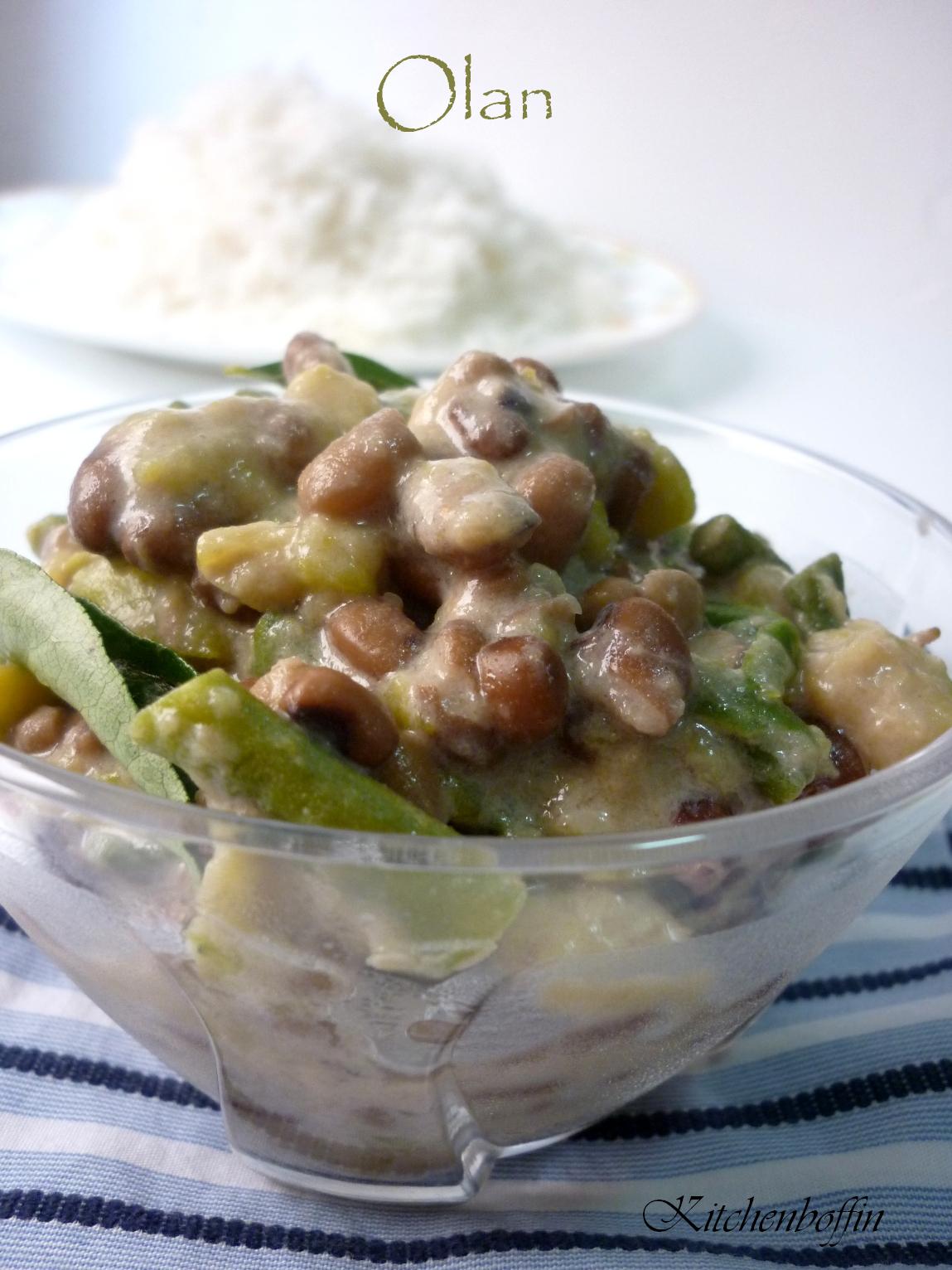
Olan - A Kerala vegeterian sadya delicacy


               So... Where to start?

            After leaving blogging behind for almost five months, I seriously don't know how to start again..

          My fingers feel numb from laziness... and my brain refuses to exude anything intelligible..

      Guess what! I seriously believe, these organs would become vestigial if you don't use it for a long time.. ;)

So, let's stop poking the past... and begin again...

      After a long vacation in India, precisely Kerala, what comes to my mind is one of the simple vegetarian sadya dishes which hails from God's Own Country, Olan.


I have had the picture in my draft for some time.. and thought to post it so as to start blogging again. Actually I have no time to take pictures after I cook the food ... upload it.. brighten it.. caption it... blah blah! Right now, my life is running at sixty miles an hour.. or at a higher pace... and I need to sit tight to stop myself from falling off.

      So, what was I talking about? Oh yes! Olan !
A simple dish with very few ingredients and very less spices (or not at all), it is a treat for the taste buds with its mild, yet outstanding flavour. Me and Mr.KB are Olan nuts, if you may call so, because we are simply fond of this vegetarian delicacy . As far as I know, pure coconut milk and pure coconut oil is what imparts that supple sweet flavour which even a hard core non-vegetarian decline to unnotice.

      After having fish and meet for a long week, my family craves for something 'all vegetarian'.A few days of all vegetarian meal, keeps them in demand for non-vegetarian. So, once or twice in a week,  I make all vegetarian meal for lunch, which my family enjoys with much ardor  One of the dishes which frequents these meals is Olan, which became a family favorite ever since I started making it at home.


Olan Recipe

Black eyed beans / van payar, soaked overnight and cooked- 1 cup
Ash gourd,skinned & cut to small square pieces                    - 2 cups
String beans, cut into pieces of 1&1/2 inch length                   - 1/2 cup                                              
Butter pumpkin, cut to square pieces(optional)                       - 1&1/2 cup  
Green chillies, ground                                                            - 2
Thick coconut milk                                                                - 1 cup
Dried red chillies,split into two                                                - 3
Curry leaves                                                                           - 2 sprigs
Coconut oil                                                                             - 2 tsp
Salt to taste

Method:
  •  Cook ash gourd, pumpkin, string beans and dried red chillies together with 1/2 cup water and adequate salt.
  • When the vegetables are well cooked (almost mushy),add ground green chillies and cooked beans to it and cook further for 5 minutes.
  • When the gravy starts drying up, add the coconut milk and stir well.Switch off the heat and pour coconut oil over the Olan. Add curry leaves and stir to combine.
  • Serve hot with rice.


Jun 26, 2012

Kappayum Irachiyum (Tapioca cooked with beef)-Malabar Style


                This is a dish which doesn't need a second introduction to Keralites. Tapioca had been and still is a   staple food in many parts of Kerala. For the same reason there is a myriad of delicious dishes made with tapioca unique to the Kerala cuisine. Combination of tapioca with meat as well as fish is widely popular and enjoyed by people from every walks of life. The small local crappy restaurants with the board, reading, "Kappayum irachiyum ivede kittum"(tapioca and beef is available here) is a common site in villages and suburban towns. In fact, it is one of those dishes which always bring a few of the childhood memories back home.
           

              Homely food has always been alluring and appetizing to me as well as some of my friends. Apart from eating, memorising them with touches of poetry and a whole lot of 'Oohs' and 'Aahs' is my friend, S's favourite pass time.(Not that I don't enjoy it :)). She has tricked me into making a hell lot of dishes with her little bit exaggerated exclamations. It was one of those nostalgic narrations about 'Kappayum beefum',which made me drool like a dog and pushed me into the act of writing 'Tapioca' under the list of 'urgently needed things' on the weekend purchase. How impatiently I waited for those tapiocas to reach home so that I could throw my culinary fists around it to quench my greedy cravings!  And I thoroughly enjoyed the 'Oohs' and 'Aahs' Mr.KB send forth, while he devoured it with undiluted devotion.

        Usually while making 'Kappayum Irachiyum', the tapioca and beef are cooked separately, then combined and cooked in low heat to blend the flavors well. The tapioca is usually boiled with a lot of water and then drained. It is then combined with cooked beef and cooked further to attain that pulpy,pudding like gravy. This dish tastes great when prepared with 'fresh from the farm' tapiocas as was made back home. As I couldn't get fresh tapioca here, I used frozen tapioca and it was not bad after all.


Kappayum Beefum- Malabar style

Things you need:


1/2 kg Indian beef , cut into small cubes
1 kg tapioca, cut into small pieces
7 to 10 shallots/ cheriyulli, sliced
1 tsp ground ginger
1 tsp ground garlic
1/2 tsp turmeric powder
1 tsp ground red chillis
1 tsp ground black pepper
2 tbsp coriander powder
1/2 tsp fennel seeds/perum jeera
Salt to taste
A sprig of curry leaves

Method:

Cook the tapioca with adequate water and salt. Drain and keep aside. Cook the beef with adequate salt and all the other ingredients in a pressure cooker until well cooked.Now mix the cooked tapioca with the cooked beef in a heavy bottomed sauce pan and cook in medium to low heat until the tapioca becomes gummy and thick and the tastes well blended. Take care to stir occasionally to prevent it from sticking to the bottom of the pan.When it is well cooked and well  blended add curry leaves and stir to combine. Remove from heat and serve hot.

Jun 6, 2012

Vendakka Pachadi / Okra (Ladies finger) Pachadi


        There are certain vegetarian delicacies which outplays non-vegetarian dishes with their unique flavour and ambiance. Hence they come handy whenever you run out of chicken and fish. There are times when you forget about the bowl of fried fish sitting infront of you and go on eating those vegetarian dishes; totally hooked. There are many Kerala Sadhya preparations made with vegetables and yogurt which are deliciously flavoursome that you hardly notice, you are eating veg. which is otherwise considered to be bland.( Vegetarians, don't take offense! I was only quoting the general assumptions of a non-vegetarian :))

            Pachadi is a dish prepared with vegetables or fruits tempered with yogurt and spices and is an inevitable dish in the Kerala Sadhya. Wide varieties of vegetables like squash, okra, bitter guard and brinjal and fruits like pineapple too are used in pachadi preparations. This is a very easy, quick and delicious pachadi which my mom in law used to make, which I was totally fond of. So when I took over cooking in 'my kitchen empire', I started preparing it whenever I got a handful of fresh okras every now and then, which my son and better half loves to the last bit.


Vendakkaa Pachadi

Okra/ ladies finger  -  1/2 kg
Fresh yogurt           -  1 cup
Turmeric powder    - 1/4 tsp
Red chilli powder    -  1/2 tsp
Vegetable oil           -  2 tbsp
Salt to taste
Coconut oil             - 1 tsp
mustard seeds         - 1/4 tsp
Dried red chilli         - 2
A sprig of curry leaves

Method:

     Wash, drain and cut the okras into thin slices. Mix the spice powders and salt with it and keep aside. Heat a non-stick frying pan and shallow fry the sliced okras in vegetable oil. Transfer it to a bowl and add yogurt. Mix it well.
      In the same frying pan, add coconut oil and splutter mustard seeds in it. Add the dry red chilli and curry leaves and saute for a few seconds. Pour this seasoning over the okra-yogurt mixture and stir to combine. Serve immediately with steaming rice and curry.

May 31, 2012

Fish curry with Coconut milk


          If there is one thing that Mr. KB would have, again and again without getting sick of it, it is the Spicy fish curry. When I am about to serve lunch, he would ask,"What's the curry?" and when I name the usual vegetable curries I prepare, he would show a "Well, bring it on. I don't mind" kind of attitude. No particular interests nor any exuberant joy. But when it is the fish curry, I see a quaint twinkle in his eyes and a sense of decadent zeal.


            Mr. KB is a man of inhibitions, unlike me who goes really weak on the knees in front of delicious food. He never fly over the top, even if he is enjoying his favourite food. So it was unlike him to pour curry into his plate and lick it with fingers even after he had done with the rice; which is what happened the other day when I prepared the fish curry."Great! Great! So much for inhibitions" I thought. Anyway it is amusing to see that you can bring out the 'barbarism' in people with your food sometimes.

            I used gamboge (Kudampuli) in this fish curry. Gamboge is rarely used in fish curries in the northern Kerala side, but in the south, it is very common. So I have a suspicion that this is a Southern Kerala fish curry though my mom makes it often, the source from which she got the recipe is unknown to me. Another speciality is the addition of thick coconut milk which mellows the fierceful flavour to some extend. In my mom's words,"The quality of the coconut milk determines the taste of the curry". So go for very thick and undiluted coconut milk for better results.

             And of course, the clay pot; which is inevitable for that great flavour. There is more than just flavour to using an earthen pot. The acidity of the gamboge or tamarind which is almost always used in Kerala fish curries may react with the vessel in which the curry is prepared and stored if a metal pot is used. Cooking it in a clay pot (earthen pot) helps to avoid this situation, thus making it more healthier. That must be the reason why fish curry in Kerala is inevitably prepared in clay pots. I am so obsessed with my clay pot, which my mom send from Kerala a few years back, that I would trade anything for it. If you are a more fierce fully spice tolerant kind of person, try my 'fish curry without coconut milk' (meen mulakittathu) which I posted earlier.


Fish curry with Coconut milk:

1/2 kg fresh pomfret or any other fish with thick flesh, cut into pieces

8 to 10 shallots, sliced
2 to 3 cloves of garlic, sliced
a small piece of ginger, sliced into thin pieces
1/2 tsp of turmeric powder
2-3 tbsp of red chilli powder/ kashmiri chilli powder if you are on the low spice level
2 tsp of coriander pdr
2 bells of gambooge or 'kudampuli'
1 1/2 cups of water
1 1/2cup of thick coconut milk
Salt to taste
1 tbsp veg.oil

For tempering:

1 tbsp of coconut oil
a sprig of curry leaves.

Method:

Heat an earthen pot and add vegetable oil. Add shallots, garlic and ginger when the oil is hot. Saute for a few minutes. Now add the turmeric powder, red chilli powder and coriander powder and saute in low heat for a few minutes. Add water to this and increase the heat. When it comes to a boil, add salt and gamboge. Then add the fish slices and cook covered in medium heat for ten minutes or until done. When the fish is well cooked, add the coconut milk. When the mixture starts to boil, remove from heat and pour coconut oil on top. Garnish with curry leaves and serve hot. It goes well with rice, appam, puttu and parottas.
       
       This post also goes to the Kerala Kitchen Event created by Ria and Rose of The Kerala Kitchen, being hosted by Jehanne of the cookingdoctor.

May 10, 2012

Mampazha Pulisseri

         Some things never seize to charm you even if you have gone a long way from it. Even while living in very different situations or in an entirely different world they tempt you and churns you in a pool of utter longing. When talking about traditions, homeland, cultures and cuisines to which you were born into, the condition is no different. Being a Keralite I often get such pangs in my heart and longings to get near to my motherland, while living far away from it.


         Those longings to feel the breeze around your ancestral home, to smell the fragrance of those jasmines which grew in your mother's courtyard, to walk in utmost tranquility listening to the chirping of the local birds, to feel the coolness of monsoon as it hits your eyebrows and drips down your face, to inhale the smell of the soil as monsoon hits it for the first time... and of course biting into those exquisite tastes of home, as if there is no tomorrow...

         I know I am not alone in this guttural craving for mother land. I have seen lot of Keralites in the air port with baggages as big as a warehouse stock on their pursuit to 'take their home land' to where they live. I have often seen officers smiling at seeing the most unusual things in baggages like large earthen pots to huge jack fruits and yes, coconuts too. It some times end up in making the poor man or woman, untie and display the strange belongings of those baggages in front of everybody concerned, due to suspicion of bombs. It has often reminded me of the ants with a block of sugar (more than double their size) on their back struggling to reach their far away nests.

             So, it is mango season again. The time of the year when every mango tree in Kerala is abloom with a thousand mangoes and every urchin is busy climbing mango trees and eating as many mangoes their little tummies can have. If only I could go back to my carefree childhood of climbing mango trees and jump from them screaming when the 'puliyurumbu'(wild ants) start to crawl over you... Sigh!  This is the season when the homes smell of all the varieties  of mango dishes under the sun. But we seldom made Mampazha pilissery (made with ripe mangoes) at home. I was introduced to this lip smacking dish by one of my friends' mom. Later I used to have it from our hostel on every Wednesdays. It was the only day of tthe week, I ate rice with great relish and hunger.


         We get Kerala mangoes here from a local Indian supermarket. Last week we got  some ripe 'moovandan manga' (local Kerala mango) and I made mampazha pulisseri with it. My family enjoyed it so much that I thought I would share the recipe of this incredibly yummy, sweet and tangy curry.

Mampazha Pulisseri / Ripe mangoes cooked in coconut and yogurt gravy

Things you need:

3 ripe mangoes ( preferably local Kerala mangoes), skin removed
1/2 tsp turmeric powder
1 tsp red chilli powder
1and 1/2 cups thick yogurt
For grinding:
3/4 cup grated coconut
2 to 3 shallots
1/4 tsp cumin seeds/jeera
1/4 cup water
For tempering:
1 tbsp coconut oil
1/4 tsp mustard seeds
1/4 tsp fenugreek seeds/ uluva
1 or 2 dry red chillies
a sprig of curry leaves

Method:
 
1) Cook the mangoes in adequate  water with salt, turmeric powder and red chilli powder until soft.


2) Grind the coconut, cumin and shallots with water and add this to the cooked mangoes and mix gently.Allow to cook for a couple of minutes in low flame.

3) Blend yogurt with 1/4 cup of water and add this to the curry in low heat. Add adequate salt and remove from heat.

4) Heat oil in a pan. Splutter mustard seeds. Saute the fenugreek seeds, dry red chillies and curry leaves in it. Pour this seasoning over the curry and mix gently.

5) Serve hot with plain rice.

Apr 25, 2012

Padavalam Parippu Thoran

           
              You must have noticed by now that I have posted a variety of Thorans in KB till date. Being a Keralite, I cannot help making thorans as they are the most commonly eaten side dishes at home ( with rice) and with out one the lunch seems bland and uninspiring. Coconut being an important ingredient of Thoran, I am sure that people beyond Kerala (where coconut is not abundant) doesn't make thorans at home, as obsessively as a Keralite. I usually temper the thorans and upperis (mezhukku puratti) with coconut oil to impart that real authentic taste.

             This is a Thoran made with Snake gourd or Padavalam and lentils, which I frequently make at home and my family enjoys. Just thought of sharing it with you..


Padavalam Parippu Thoran


Things you need:

Snake gourd/padavalam - 250g
Red lentil or yellow lentil (parippu) -1/4 cup
Grated coconut         -  1/4 cup
Green chilli                -  2 to 3
Shallots/pearl onion (cheriyulli) -3
Garlic                                      - 2 cloves
Turmeric powder                     - 1/4 tsp
Salt                                          - to taste

For tempering:

Mustard seeds     - 1/4 tsp
Cumin seeds/ cheriya jeera  - 1/4 tsp
Shallots, sliced                     - 2
Dry red chilli /vattal mulaku  - 1 or 2
Curry leaves                        - a sprig
Coconut oil                          - 1 tbsp

Method:

  1. Skin and seed the snake gourd and slice it to small thin slices. Pulse the coconut along with the green chillies, shallots, garlic and turmeric powder.Cook the lentils in a little water and keep aside.
  2. Heat oil in a pan and slutter mustard seeds and cumin. Add sliced shallots and red chillies and saute for a few minutes. Now add curry leaves and add the pulsed coconut mixture. Add the sliced snake guard to this and stir well until combined. Add 1/4 cup of water and salt and cook covered until done.
  3. Add the cooked lentils to this and serve hot with rice.

Mar 17, 2012

Semiya Payasam / Vermicelli Kheer


                  When was it that the parties in Kerala started serving exotic puddings and sophesticated desserts to entertain the sweet tooths? Not long, I guess. Because all the  childhood memories I have about parties were smeared with a delicious and impressive batter of payasam. It was the soul of a party, a celebration and a get together. Without a payasam, the 'salkarams' were never complete. In fact, two decades back, 'malayali' never knew a dessert other than payasam or its variations.

                    The small talks and chatters reverberates in my ear still though I was small and indifferent towards grown up talks. "Payasamundu.. Choodode kudicholoo" ("Payasam is ready.. Drink it while it is still hot") That is the host inviting the guests for a round of 'payasam' when they are preparing to leave. So they stay back to sip a warm cup of payasam and another round of gossips and small talks. And the 'salkaram becomes more lively again.


                     Semiya payasam is one of the simplest payasams from the myriad of payasams in Kerala cuisine. I prepare it often as it is Mr.KB's and junior's favourite. Junior KB asks,"Mom! why should you prepare rice,rottis and curries all the time? You could prepare payasam instead,right?" As I perspire to answer his question, I can hear myself, a little KB, nagging her poor mom with such unanswerable questions. As the elders in family, tease me saying I had the most notorious doubts of all my siblings, I guess the history repeats itself.. :)


Semiya Payasam Recipe:

Things you need:

3 cups full fat milk
1 cup of sugar or to taste
1/2 cup broken vermicelli / semiya
3 tbsp ghee/clarified butter
1/2 tsp cardamom powder/elakka podi
2 tbsp raisins
2 tbsp cashews
1/2 cup of condensed milk (optional)

Method:

Heat a heavy bottomed saucepan or 'Uruli'(a round brass vessel typical of Kerala) and add a tablespoon of ghee to it. Add the vermiselli to it and stir fry for a few minutes in medium heat until it turns golden brown. Now add the milk to it and bring to boil. Add sugar and stir well until dissolved. Cook on medium heat stirring continuosly until the vermicelli is tender and well cooked. Now add the condensed milk (if using), stir well and remove from heat. Add the cardamom powder to it and stir.
                 Heat a frying pan and add the remaining ghee to it. Add raisins and cashews and saute until they turn golden brown and the raisins puffed up. Garnish the payasam with this along with the ghee. Serve hot or cooled.

Mar 13, 2012

Ayala Thoran / Mackerel sauted with coconut and spices


              Fishes are yummy. Life without fish is unimaginable. If they were bone less they would have been all the more desirable. I always muse about bone less fish variations when I watch Mr.KB meticulously eat his fish. If they are smaller fishes like sardines and mackerels he spend hours eating his fish, painfully fishing out each and every fish bone and delicately arranging them over the circumference of his plate. As for him, he may be able to swallow a needle, but not a fish bone (no matter how minute it is). I try to trick him sometimes, explaining about the loads of Calcium in fish bones and the virtue it is going to do for his bones but nay.. he never budges. He toss the ball back with a classic comment of his own."My bones are already overloaded with Calcium. So may be, I could spare some for you" Nope! Fishes and him- they binds easily. But as for fish bone- He avoids it like plague!


               When I got this recipe of 'Ayala thoran' I had thought, "Well, Mr.KB loves mackerels and when it is boneless he is gonna love it even more". And I was right when the thoran was devoured in haste and much relish. As for a Keralite, any dish can be made yummy with the addition of coconut to it. Hence there are as many varieties of 'thoran' in Kerala as there are coconut trees in it. So it is not a surprise that you can find thorans made with fish, meet and eggs other than vegan thorans. I tried this Ayalathoran, keeping my fish loving (fish bone hating) hubby in mind and it was helped into both father's and son's belly faster than I imagined. My son called it "scrambled fish" and he enjoyed it like his favourite scrambled eggs. Spicy and piquant, it sure is a yummy side dish for lunch or dinner, though it takes a bit of your time to remove the bones of fish prior to mixing everything up.

Ayalathoran Recipe

Things you need:

3 large mackerels( ayala)
2 pieces of gambodge( kudam puli)
1/4 tsp turmeric powder
1/2 tsp chilli powder
Salt to taste

For the coconut paste:

1,1/2 cup grated coconut
1 green chilli
2 cloves of garlic
1 small piece of ginger
1/2 tsp  whole black pepper
5 shallots / pearl onions/ kunjulli

For tempering:

1 medium sized onion, diced to small pieces
2 tbsp veg.oil
1/4 tsp chilli powder
1/4 tsp turmeric powder
1/2 tsp mustard seeds
1 or 2 dried red chillies
1 tsp black grams/uzhunnu parippu
2 sprigs of curry leaves


How to:

Clean and wash the mackerels well and drain.Cut them into big pieces and cook in a vessel adding turmeric powder, chilli powder, gambouge ,salt and adequate water. Remove the bones,smash them up and keep aside.
  Pulse the second ingredients in a mixer until, coarse powder.
   Heat oil in a heavy bottomed pan and splutter mustard seeds, red chillies, black grams and curry leaves.Add the diced onion and saute until golden brown. Add turmeric and chilli powders to it and saute. Then add the pulsed coconut mixture and saute for a few minutes. Finally add the cooked fish and mix every thing well. Adjust the salt and remove from heat. Serve hot with rice.

Recipe courtesy: Lakshmi Nair

Sending this to Kerala Kitchen Event hosted by Prathibha of COOK EZEE started by Kerala Kitchen

Mar 1, 2012

Beetroot Thoran


                      When I was small and school going, we seldom made beet dishes at home and so it was never send to school with my tiffin of lunch. Some of my classmates used to bring it with rice and I used to look in awe as the colour of their rice changed to pink when the beets were mixed in it. I always envied them and had tried to befriend them. In my eyes, the beet eaters were superior to non-beet eaters simply because they could change the colour of their rice to pink and I had felt myself inferior.

                       When this inferiority complex took hold of me hard, I said to my mom one day, "Well, today onwards, I want beets for lunch. If not, I'm not gonna go to school anymore". My mom wouldn't have understood a bit about my beet love, but nevertheless she included it in my lunch the next day onwards because she couldn't risk the halting of her daughter's schooling. So I was lifted up into the hierarchy of beet eaters in my class and never ever felt inferior again. 


                    This recipe of beetroot thoran is the most common form cooked in northern kerala and is quite delicious on its own.

Beetroot Thoran Recipe:

Things you need:

4 beetroots, skinned and cut into small square pieces
1 cup of grated coconut
2 green chillies
1 tsp mustard seeds
1 sprig of curry leaves
1 tbsp coconut oil
Salt to taste

Method:

Cook the beets in a covered vessel with little water and adequate salt. Pulse the coconut and green chillies in a mixer and keep aside. Heat a frying pan and add coconut oil. Splutter mustard seeds and curry leaves, Now add the pulsed coconut and saute for a minute. Finally add the cooked beets, mix everything well and remove from heat. Serve hot with rice.

  Sending this to Bon Vivant Moments #2 - Savoury Items at Sumee's Culinary Bites

and to CC event Vegan Diet at Srav's Culinary concepts  
and also to Walking through memory lane event hosted by Roshan of Roshan's Cusina started by Gayathri of Gayathri's Cookspot


Jun 1, 2011

Avial


                        Small joys have their own pains.You cannot reach the top of a hill and luxuriate in the picturesque scenery around, without a little bit of sweat perspired on your hike. So when you are expecting your baby with a lot of woven dreams, you cannot help but face a bit of pesky troubles b'fore you receive your bundle of joy in your hands.

                      When the so called morning sickness became more like a whole day sickness, and making daily dishes or even entering the kitchen with out the nagging nausea became impossible, I was quite up the creek. It's needless to say I couldn't satisfy the greedy guts of my son or his father nor could I keep my good humour up.What's more.. the jack fruits and mangoes which grew in India (plucked fresh from the trees and not exported) tempted me like never before. And I longed for the luxury of not having to prepare everything by myself and just eat the yummy dishes mom prepared, when she calls, “grub’s up”. You would have guessed by now the reason for my quite sudden disappearance from the blogosphere as if into thin air. Well, I am happy to be back, though I cannot promise a post in every alternate days.

             So well, I had no other choice but to catch the next plane possible and fly to fulfill my dream, though it cost my hubby a fortune. (May Almighty Allah bless him ) So yes! I am now in India, with almost all those wishes fulfilled (thanks Allah) and feeling quite well perhaps and planning to fly back next month.

             I was also lucky enough to witness the summer showers which came as a cool comfort in the scorching heat. It was jus’ fantastic and I candidly enjoyed it like my excited son who was witnessing his first sight of real rain. Rain always lifts my mood up. I have always found it kinda euphoriogenic. That must be why I got an enthusiasm to post something after the long break.

             I thought of posting something my mom prepares and I have always been the greatest fan of her Avial, the yummy vegetarian Kerala delight. More than often I have ended up licking the earthen pot in which she prepares it with much ardour. I also used to prepare it when ever we come to the end of a purchase and we have a little bit of different vegetables leftover. I usually prepare it adding yogurt.You can also prepare Avial adding tamarind or raw mango for the sourness. Here is the recipe..


Avial

Things you need:

Elephant yam         - 100g
Ash guard              - 150g
Cucumber              - 150g
Snake guard           - 100g
Carrot                    - 1 small
Brinjal                    - 1 medium
Drum stick             - 1
Raw plantain          - 1
Spring beans          - 5
Green chillies         - 6
Turmeric powder   - 3/4 tsp
Chilli powder         - 1/2 tsp
Cumin seeds          - 1 1/2 tsp
Grated fresh coconut  -  1
Yogurt , beaten          -   2 cups
Coconut oil                -   50 g
Salt  to taste

Method:

  1. Coarsely grind the coconut, green chillies and cumin seeds and keep aside.
  2. Wash and cut all the vegetables into equal sized pieces of two inches.
  3. Heat an earthen vessel and add a little coconut oil into it. Add the elephant yam  and saute for a few minutes.Pour a little water and cook it in low flame for a few minutes. When it is half done, add the rest of the vegetables, turmeric powder, red chilli powder, salt and adequate water and cook in low flame, covering the vessel.
  4. When the vegetables are well cooked , add the ground coconut mixture, flatten it over the cooked vegetables with a spatula and keep the vessel covered until vapour passes through the coconut mixture. Then open the lid and mix the vegetables and coconut mixture evenly and switch off the flame.
  5. Add the beaten yogurt and mix well. Garnish with curry leaves and coconut oil and mix well.
  6. Serve hot with rice.

Jan 30, 2011

Ethappazham Pulissery

           Raw green plantains have long been used in many vegetarian preparations in Kerala. Pulissery is a dish which uses yogurt or curd and ground coconut in it and which is some what sour in taste. Vegetables and fruits like ash guard, pine apple and plantains are usually used in the curry. Ethappazam pulissery uses raw or ripe plantains in it. Here I have prepared it using raw plantain.


Here is the recipe..

Things you need:

1Green plantain/ Pachakkaya, chopped
1/4 tsp turmeric powder
1/2 tsp red chilli powder
2 cups curd or yogurt
Salt to taste
For grinding:
1 cup grated coconut
1 green chilli, slit
2 to 3 shallots
1/4 tsp cumin seeds/ jeera
1/4 cup of water
For tempering:
1 tbsp coconut oil
1/2 tsp mustard seeds
1/4 tsp fenugreek seeds
3 or 4 dry red chillies (optional)
A sprig of curry leaves

Procedure:

1) Cook the plantain in a little water with salt, turmeric powder and red chilli powder until soft.

2) Grind the coconut, green chilli,cumin and shallots with water and add this to the cooked plantain and mix gently.Allow to cook for a couple of minutes in low flame.

3) Blend yogurt with 1/4 cup of water and add this to the curry in low flame. Add adequate salt and remove from flame just before the curry starts to boil.
4) Heat oil in a pan. Splutter mustard seeds. Saute the fenugreek seeds, dry red chillies and curry leaves  in it. Pour this seasoning over the curry and mix gently.

5) Serve hot with plain rice.

      And my friend and class mate, Sreeja- The small town girl has given me a cute award. Thank you Sreej, for the well thought award.Do visit her blog.. She writes really funny. Some times she doesn't make much sense...but anyway they are fun to read..

Jan 7, 2011

Gothambu Payasam / Whole wheat Payasam

           
        Payasam is an inevitable dessert in most of the south Indian homes especially if there are any sweet tooths in them. This dish is usually made with cereals or pulses cooked in milk or coconut milk sweetened with sugar or jaggery. They are mostly tempered with ghee or clarified butter. They are traditionally eaten in plantain leaves as such or mixed with papad. Gothambu payasam is made with whole husked wheat and is a rich dessert after vegetarian meal.


Here is the recipe..

Things you need:

Whole husked wheat / sooji wheat   -  250g
Jaggery                                            -  500g
Ghee / Clarified butter                      -  150g
Coconut milk                                   -  of two coconuts
Full fat milk                                      -  1 Lr
Cashew nut                                     -  150g
Raisins                                            -  150g
Cardamom, powdered                    -  50g
Dried ginger powder                       -  a pinch
Chiselled coconut pieces                 -  2 tsp


Method:

  Wash the husked wheat and cook well in a pressure cooker in low heat adding adequate water. Dissolve the jaggery by heating with half a glass of water and keep aside. In a wok or sauce pan mix 100 grams of ghee and the cooked wheat and add the dissolved jaggery staining through a sieve. Heat the wok and stir continuously in low heat. Mean while add the full fat milk and cook by stirring continuously. When it starts to thicken add the powdered cardamom. When the mixture thickens to the consistency of a pudding, add the  coconut milk and remove from heat just before it starts to boil. In a pan heat the remaining ghee and add the chiselled coconut pieces and saute until brown. Then add the cashew nuts and raisins and saute until brown. Add this to the payasam . Sprinkle with dried ginger powder and stir well. Serve hot or cold.

Recipe courtsey: Vanitha

Nov 11, 2010

Meen Mulakittathu / Red hot Kerala fish curry

                Is there anything more tempting than a red hot fish curry... as far as spicy food lovers are concerned? This post is for Chini, a blogger friend who had asked for a really authentic home made fish curry... red hot - she had mentioned that. This is a recipe I should have posted much earlier but somehow had procrastinated. I have always preferred home made fish curries to the restaurant made ones because the restaurant types are mostly benign and usually lacks the mesmerising and fierceful (I don't know why I use both words at the same time..) blend of flavours. You should know what I mean when you are having one and your eyes and noses are running like hell... but you still cannot stop having more :)


              Well, that is what home made Kerala fish curry is about. So those who are less tolerant to spices, or weak at heart may better keep away.. or you wouldn't know when you will dissolve into tears :) Well, if you ask me " Is there any option to make it less hot without sacrificing the taste?", yes there is! Substitute the red chilli powder with Kashmiri chilli powder. This oughtta save your tears.. because Kashmiri chilli powder is less hot compared to ordinary Indian chilli powders but gives a very beautiful scarlet hue to your curry. And the greatest tip for the traditional taste is to cook it in an earthen pot and would taste even better on the next day or evening. So.. are you ready to go? Then grab your resources! Here is the recipe..

Things you need:

1/2 kg fresh pomfret or any other fish;washed , drained and cut into pieces
1/4 tsp fenugreek seeds
8 to 10 shallots, sliced
2 to 3 cloves of garlic, sliced
2 medium sized tomato, chopped
1/2 tsp of turmeric powder
2-3 tbsp of red chilli powder/ kashmiri chilli powder if you are on the low spice level
2 bells of gambooge or 'kudampuli'
2 cups of water
Salt to taste
3 tbsp of coconut oil
1 sprig of curry leaves


Method:
       Soak the gambooge in 4 tbsp of warm water for ten minutes. Heat a heavy bottomed earthen pot and pour 2 tablespoons of oil to it.Add the fenugreek seeds and saute until brown. Then add the shallots and garlic and saute until transparent. Now add the turmeric powder and red chilli powder and saute. Add the chopped tomatoes and saute until the tomatoes become pulpy and the oil starts to surface. Add water and increase the heat. When the gravy comes to a boil, add salt and the soaked gambooge along with the water. You can also use ordinary tamarind instead of gambooge. Now add the fish pieces and cook in medium heat covering the pot. Remove from heat when the fish is cooked and gravy starts to thicken. Sprinkle the remaining coconut oil over the surface. Garnish with fresh curry leaves. Serve hot with rice or chapattis.

LinkWithin

Related Posts Plugin for WordPress, Blogger...